
CRISIS
Peloponnesian War: Warring states, a slave revolt anda battle for hegemony in the Greek empire
CRISIS
Prior to any war between Athens and Sparta, Greece was a united front as they had a common enemy: Persia. Greece and Persia have often been at war but to understand this topic we’ll go back to around 499 B.C. At this time the Ionian Revolt started and with it the first phase of the Greco-Persian Wars. Between 492 and 490 B.C., Greece was invaded by Persia. During this excursion, Persia managed to retake control of territories that had been under their influence and turned Macedonia into one of their subordinates. Soon after, all major Greek cities started receiving ambassadors from Persia who demanded submission to their Kingdom. Among all the cities only Athens and Sparta didn’t agree to cooperate and executed those who came with such demands. Enraged by the response, a new military campaign was sent to Greece with general success in the Aegean region. However, between 490 and 480, the Persian demands were slowly being rejected whilst Athens and Sparta strengthened. With time, all the defiant Greek cities joined the two and in 481 they built a confederate congress of unified citystates.
Over the next years, the city-states continued establishing themselves by building political alliances. With that, the Delian and Peloponnesian Leagues led by Athens and Sparta respectively gained force. The Delian League reached over 300 members all of which paid tributes (monetary or naval) in return for protection in case of a Persian threat. The Peloponnesian League worked similarly but instead of tributes, all members swore to have the same allies and enemies as Sparta and provide troops.
However, as time passed the Persian threat began to be left behind and rivalry started to be built between them. Thucydides, who is widely recognised for writing a thorough narrative of the war, states that the causes of the Peloponnesian War stem from the 5th to as far as some of the 6th century but the root of this conflict is Sparta’s fear of Athenian expansion.
Geographically, Athen’s allies covered a majority of the states around the northern and eastern shores of the Aegean, effectively possessing hegemony over the Greek waters. In contrast, Sparta’s allies were located mainly on land, around the Peloponnese and central Greece, except for the sea power Corinth.Furthermore, Athen’s emergence as the head of an empire as opposed to its previous alliance saw it become the most dominant force militarily, geographically and financially in all the Greek world. Due to these differences, and to the dismay of Sparta, Athens was able to build an even bigger and stronger navy which sowed further doubt as to whether Corinth would continue its alliance with Sparta now that rivalry existed between them. At this point, the often-called First Peloponnesian War started a 15-year-long conflict between Athens, Sparta, and their main allies. During the beginning stages, Athens suffered on land while Sparta lost almost all naval battles. These battles mainly involved Athens and Corinth although Sparta intervened sporadically, starting in the Battle of Tanagra (457) where Sparta achieved a pyrrhic victory.
Returning from their defeat, Athens started to attack other cities with a raging success, many of which were added to the Delian League. In 452 Athens suffered yet another significant loss after being defeated by the Persians in Egypt (a war they had in parallel). Due to such a setback, a 5-year truce was started but even once they returned the captured cities started to rebel and regained their independence. By 445 B.C., the Thirty Years’ Peace was signed with Athens on the losing end. The treaty established Athenian concessions in the Aegean Sea and an arbitration process for disputes between the two sides. Additionally, it recognised the two Leagues as legitimate and allowed neutral city-states to join either side as they wished but did not allow states already aligned with either side to enter into an alliance. Finally, it stipulated that Sparta and Athens would limit their intervention in other Greek disputes.
THE DIRECTORS


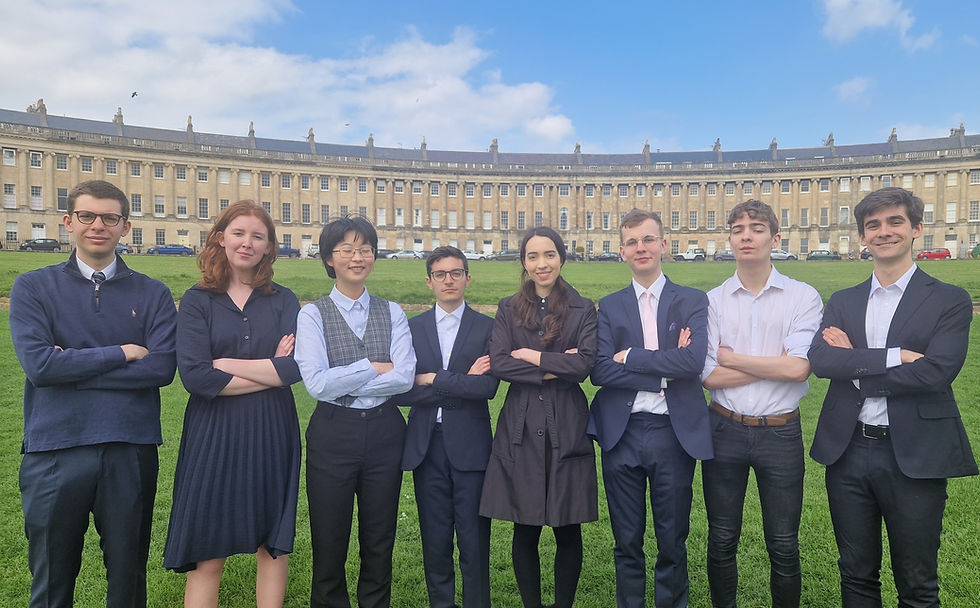
EMILY ANSELL
CO-DIRECTOR | BATHMUN
Emily is a Politics and International Relations student. Originally from Portsmouth, UK she has been participating in Model UN for over 4 years. She currently balances her new role as the society's training secretary with planning the crisis committee for Bath’s conference. In practice, this means she spends lots of her time dreaming up new ideas for training activities, and even more planning fictional coups. Outside of MUN, Emily can usually be found tending her jungle of houseplants, exploring the city with friends, or mending yet more kit she’s broken whilst training with the archery club.
OTTO OLDRIDGE
CO-DIRECTOR | WARMUN
Otto is a PPE student from the University of Warwick who has the pleasure of partnering with Emily leading this crisis. He has a plethora of crisis experience from across the MUN circuit and can't wait to get started in December.
THE CHAIRS


MOLLIE MCGOWAN
CHAIR | LSE MUN
Hello! I’m Mollie, a second-year student at LSE studying Politics and International Relations. I am so excited to be a chair for this year’s conference and I’m really looking forward to working with you all to dissect this crisis however you choose! We’ve got loads planned and are trying to make this the most valuable and exciting experience for you as possible. I’m looking forward to meeting you all in Bath in December!
ROB SUNNUCKS
BACKROOM CHAIR | WARMUN
Hey! I'm Rob, a postgraduate student studying Mathematics of Real-World Systems who has the honour of working in your backroom for BathMUN 2023! I cannot wait to see what you all end up doing over the course of the conference. I hope that we have created an environment where you can all flourish and have a hell of a lot of fun! See you all in December.
HENAR
MAÍLLO
CHAIR | UNA EUROPA
Hi! I'm Henar, I'm a Spanish madrileña and I do European Studies at Una Europa. I've been doing MUN for 6 years but to get to know me I'd say I'm a poet at heart and activist as a daily plan. Meet you all soon!
THE BACKROOM


